Showing posts with label dark. Show all posts

Tuesday, December 1, 2015

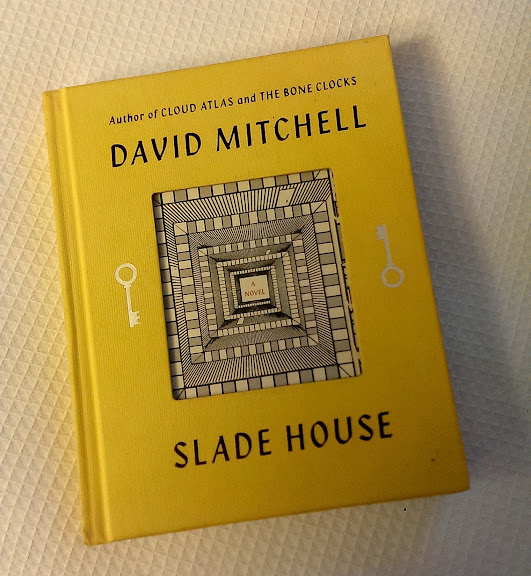
Slade House, by David Mitchell

I really enjoyed this book but explaining why is complicated.

First, I should say that before Slade House, I read every other David Mitchell book except for The Thousand Autumns of Jacob de Zoet*, I believe in this order:

Though I was struck by the gorgeous and skillful language of all five, Bone Clocks was far and away my favorite. Soon after, I read a review in the NY Times where the critic wrote that it "felt like a misfire," with a plot that "felt soft and formulaic" and read "like second-rate fantasy fiction" (of course, I vehemently disagreed!), and that the recurring characters from Mitchell's previous books seemed “less like Yoknapatawpha and more like Marvel.” Not having read any of his other books at the time, this didn't mean much to me, but I did pick up on the fact it wasn't intended as a compliment.

Over the last year, though, I've read everything except Jacob*, so now I see what he was getting at: Although the books are all self-contained, they do all seem to take place in the same universe, with the same characters or clans of characters appearing regularly (sometimes as central figures, sometimes as cameos), and taken as a whole, I could sort of see Mitchell weaving together a larger story, each book existing in its own little narrative eddy. So it was unsurprising to me to hear that Slade House was sort of a sequel to Bone Clocks.

For better or worse, that was the effect of reading Bone Clocks first. It's definitely the most explicit, sprawling, lay-it-all-out, this-is-what's-going type of story of the six, and I can see how someone might not pick up all the connections if they started with Ghostwritten and read according to publication order. I also think maybe that explicitness was what some people didn't like about Bone Clocks, having become accustomed to the oblique nature of the books that came before. (Also, I'm a huge fan of what you might call "intellectual horror" or "literary horror" or whatever, which I think Bone Clocks has a lot in common with, and I can see maybe a subset of Mitchell's usual audience not really going for that.)

So. I say all that to say that if you enjoyed Bone Clocks, you are more likely to enjoy Slade House than if you enjoyed Mitchell's other books more and Bone Clocks less. It's short, apparently an elaboration on a short story he wrote called The Right Sort. If Bone Clocks flirts with intellectual/literary horror, Slade House straight-up propositions it. The story is divided into three parts and revolves around a mysterious manor house (the eponymous Slade House), with each part following a character as they visit the house and its odd inhabitants. Not all of their fates are happy. If you've read Bone Clocks, by the second or third story you see the connection between the two books and will probably figure out sooner than other readers how it's going to end.

I can see why readers who enjoyed Cloud Atlas and Ghostwritten more might not be as big on Slade House. It's short and fairly to the point, not quite as literary, and more focused on telling a grizzly tale than on patiently and artfully developing nine-dimensional characters and abstract, highly literary themes. Still, Mitchell's skill with language and story craft in general shines through, which made it (at least for me) a satisfying, undemanding, yet highly entertaining read.

* I started Jacob in December and abandoned it after 100 pages because I just could not get into it. (Sorry, David Mitchell; six out of seven still ain't bad!)

Tuesday, September 29, 2015

Fates and Furies, by Lauren Groff

Oh, man. I don't even know where to begin with this book except that it was amazing. I actually think the marketing copy included a pretty decent summation: Every relationship has two perspectives, and sometimes the key to a great marriage is not its truths but its secrets.

The relationship in question is that of Lotto & Mathilde, madly in love and married at the tender age of twenty-two after knowing each other for all of two weeks. The first half of the book tells the story of their marriage from Lotto's point of view, and though the writing is utterly gorgeous and the characters dynamic and multi-dimensional, it's on the darker side, without much in the way of comic relief. The second half, though, is Mathilde's story, which fills in a lot of blanks in sometimes jaw-dropping ways. (Fans of Gone Girl and The Girl on the Train, this is why you'll love it.)

The genius of this book lies in the juxtaposition of the two voices, addressing issues of destiny, creative potential, and the nature & meaning of marriage. Not a light read, but beautifully & poetically written without sacrificing the authentic voices of the characters, and the complexity and cleverness offers enough relief from the darker nature of the story to make it brilliant.

Monday, September 14, 2015

A Head Full of Ghosts, by Paul Tremblay

Last Wednesday I read an article on LitReactor called "6 Reasons Everyone Should Read "A Head Full of Ghosts" by Paul Tremblay". Apparently this book has been getting rave reviews by everyone and their mother since it came out in June, but this was the first I'd heard of it. I am not much of a horror fan so I suspected it wouldn't really be my thing, but LitReactor has often steered me very very right, so I read the article. And got the book the next day, and read it the day after that.

Friends: I could not put it down. It is for sure one of the best books I've read this year, and yet 100% completely different from anything else I've read this year.

I owe the LitReactor article a lot, because the genius of this book is not really the kind of genius that is conveyed easily in a two-paragraph marketing blurb. The story follows the Barrett family (out-of-work, hyper-religious John, his cynical, frustrated wife Sarah, and their two daughters Marjorie and Merry, fourteen and eight respectively) as Marjorie descends into (severe mental illness? Demonic possession? A desperate bid to salvage the family's financial situation?). John gets the local minister involved, who in turn gets the family a reality TV deal ("The Possession"), which in turn leads to Complications, all of which is narrated by eight-year-old Merry.

That's basically the setup you get from the marketing copy, and based on that alone I probably would have skipped it because a) not really into horror and b) sounds a bit cliché, to be honest. But the real genius of this books is that it's kind of meta-horror. Instead of telling the story purely from eight-year-old Merry's perspective, Tremblay ups the ante by framing it as told by twenty-three-year-old Merry to a bestselling author who is writing a book about the events, and then interspersing those interviews with blog posts about the reality series "The Possession" written by a quirky & mysterious horror junkie. Because of the reality show, a lot of what happened is on film, but a lot of it isn't; there is also the reliability of Merry's memory to take into account. This all adds up to an undercurrent of uncertainty about what did and did not actually happen and to what extent was the situation was medical, supernatural, or faked by Marjorie and/or the exploitative reality TV producers.

In that context, the various horror clichés and tropes click into place. Rather than making the story predictable and derivative, they add layers of complexity to it and enrich the question of real/not real/supernatural/fake, and give the horror junkie blog posts lots to dig into in that obsessive-internetty-kind of way that the best bloggers have.

Finally, the dang thing is just brilliantly written, start to finish. As the LitReactor article put it, there are no bit parts. The real conflict & tension in the book is created by the interplay between complex, three-dimensional characters with vastly different goals and desires and understandings of what's happening. (I was particularly impressed with how believably eight-year-old Merry was written.)

All that said, A Head Full of Ghosts will not be for everyone. There are some disturbing scenes that, while they make complete sense in context and are not played for shock value, will be deal breakers for the squeamish (and possibly hyper-religious). But if you're more concerned with a smart, tense, well-written story that hooks you from the first page, you might give it a shot.

Books with which [book:A Head Full of Ghosts|23019294] has things in common, but is completely different than: