Friday, May 3, 2019

SMPs for Parents and Other Civilians: MP 2

This is the third follow-up post to a previous one aimed at parents and other non-math teachers, The Real Power of Studying Mathematics, about the significance of the Standards for Mathematical practice.

MP 1, Part 1: Making Sense of Problems

MP 1, Part 2: Persevering in Solving Problems

* * *

In our last two posts, we talked about MP 1--what it means to make sense of a mathematics problem (part 1) and persevere in solving it (part 2). Today, we'll continue Math Practice #2: Reasoning abstractly and quantitatively. What does it mean to reason abstractly and quantitatively? What does it look like? What does it look like to struggle with either or both? And what can parents do to support students?

Like MP 1, MP 2 has two distinct parts:

    1) Reason abstractly

    2) Reason quantitatively.

To understand the real significance of the second practice, we need to understand each of these two pieces, as well as why they are presented together in a single practice. After thinking about this for a bit, though, I find it easiest to explain if I turn it around, and we talk first about reasoning quantitatively, and THEN about reasoning abstractly.

Reason Quantitatively

Reasoning quantitatively is one avenue of making sense. (Many thanks to Grace Kelemanik and Amy Lucenta for codifying this framework, and to my colleague at WestEd, Cathy Carroll, for bringing it to my attention.) When we reason quantitatively, we're thinking about the quantities involved (goats, apples, meters, seconds, miles per hour, the x-coordinate, degrees, radians, the difference between functions f and g, etc.--basically, anything we can count or measure) and considering their relationships to one another (How does the number of goats compare to the number of apples? What is the relationship between the number of minutes elapsed and number of feet traveled? How is the x-coordinate related to parameter t?)

At a recent seminar, we spent some time working with teachers on ways to support students with MP 2. The problem stem we used for a lot of our discussion was the following:

Parkview Elementary
    Two thirds of the students in Parkview Elementary School wear something red during the last School Spirit Day. Of the students wearing something red, half of them were wearing red hats. Of the students wearing red hats, two thirds of them are boys. 53 girls were wearing red hats.

    Source: Fostering Math Practices

We call it a problem stem because, as you may have noticed, there's no question to answer at the end. The purpose of leaving off the question was to focus on making sense of the problem, rather than immediately gunning for the answer. We wanted everyone to really focus on reasoning quantitatively as they thought about the problem stem, about what quantities are involved, and how they are related.

If we were to peer into the mind of say a 5th grade student who is reasoning quantitatively about this problem, we might witness an inner monologue that goes something like this:

    "Okay, two-thirds of kids in the school wear red [Identifying a quantity explicitly mentioned in the problem]. So I'm going to draw a pie chart, divide it into thirds, and outline 2/3 in red. So I can see that 1/3 of kids are NOT wearing red [Identifying an implicit quantity not explicitly mentioned in the problem stem], which is only half the amount of kids wearing red [Identifying a relationship between two quantities, kids wearing red and kids not].

    "Of the students wearing something red, half of them are wearing red hats.' Okay, so students wearing red, that's my 2/3 that I outlined. [Identifying a relationship] And half of them are wearing red hats. Well, I can see from my diagram that half that amount is 1/3 [Relationship]. So 1/3 of the kids in the school are wearing a red hat [Relationship]. And this other 1/3 is kids who are wearing red, but the red isn't a hat [Implicit quantity].

    "Let's see...2/3 of the kids wearing red hats are boys. So where's 'kids wearing red hats' [Quantity]? Oh yeah, it's this 1/3 I labeled here [Relationship]. So I need to divide that part into thirds...And let me shade two of those parts and label them 'boys in red hats.' The leftover 1/3 there has to be girls then [Quantity AND relationship], and the problem tells me there are 53 of them, so I'll label that too."

Thus far in their thinking, this student has not performed any calculations--but they've done a *heck* of a lot of math! All this business above is an example of reasoning quantitatively--making sense of the problem by identifying explicit quantities of interest, using those to identify implicit quantities of interest, and then determining how those quantities are related to one another. As the "official" definition of SMP 2 puts it,

    "Quantitative reasoning entails habits of creating a coherent representation of the problem at hand; considering the units involved; attending to the meaning of quantities, not just how to compute them; and knowing and flexibly using different properties of operations and objects."

Reasoning quantitatively is one way to making sense of a problem, and if that's the approach I take, I can't really do anything calculation-wise until I've understood what quantities are important and how they are related.

Reason Abstractly

What does it mean to reason abstractly? In contrast to thinking carefully about the various quantities and units and how they are related given the context of the problem, reasoning abstractly means stripping away the quantities and units and other referents and working purely symbolically.

If I give kids a bunch of "naked" calculations to perform such as 24 x 7, without any context or real-world story behind it, I'm asking them to reason abstractly. The same goes for solving algebra equations like 7x + 9 = 30. There are no goats or apples or radians to think about, and all the relationships are spelled out for us symbolically; it's all just numbers and operations.

Reasoning abstractly does play an important role in solving real-world / contextual problems like the one above, though. Say for example that we give a kid a problem like:

    "There are twice as many kids wearing hats as there are kids with no hats, and there are 27 kids in all. How many are wearing hats and how many are not?"

The quantitative part is being able to say, "Ah, yes, I'm adding together two groups of kids where one is twice as big, so I need to compute 1/3 x 27 (or) 27 / 3 (or) 2/3 x 27 (or) solve 3x = 27, etc." The quantitative part is determining what calculations you need to do or what equation you need to set up or what have you, based on the quantities and relationships involved.

The abstract part is actually doing those calculations or solving that equation. It's reasoning through the symbolic manipulations in a way that has nothing to do with what the numbers or symbols actually refer to in the problem. The abstract part is, once I know I can find the answer to my problem by solving 3x = 27, being able to reason my way through with the numbers and symbols and operations and actually get an answer:

    "Ah, okay, so three multiplied by something is 27. So that means I can find the 'something' by going backwards and dividing 27 by three, which is 9."

    (OR)

    "Right, three times blank equals 27. That's a fact family I know, the missing number is 9, because 3 x 9 = 27."

Now, don't get me wrong; using the context to solve a problem is an important skill. In fact, pedagogically, having kids use a real-world context to reason through a problem is a critical tool for helping them to notice mathematical patterns and relationships and start to make sense of shortcuts they can use to solve problems more efficiently. One of the biggest problems in all of US K-12 math is that kids get pushed too quickly from solving problems intuitively in ways that make sense to them into abstract algorithms and procedures, before they've had time to see the connections between the two and transfer their understanding from the concrete to the abstract.

HOWEVER, it is still a skill we want them to have once they're ready.

Take this problem, for example:

    "I know I need to buy 4 packages of hot dogs and 5 packages of buns and that hot dogs cost $8.50 a package and buns cost $4.75, and then also there is 8.75% sales tax. How much is that going to cost me?"

It's completely feasible and logical to solve this problem by thinking:

    "Okay, I need 4 packages of hot dogs, and hot dogs cost $8.50 per package, so that's four groups of packages at $8.50, which is $34 for hot dogs. And then 5 packages of buns which cost $4.75 each, so 5 groups of buns at $4.75 each, so that's $23.75 for buns. Then $8.50 for buns combined together with $23.75 for hot dogs, that's $57.75 for the food. Then 8.75% sales tax, so if $32.25 is 100%, then 1% is $.3225. 8 of those is $2.58 for tax, and then there's the .75%..."

In fact, as kids first start to work with decimals and percents and performing various operations with them, this is 100% how I would want them to do it. I want them to take their time and think through the various quantities and relationships and use their common sense to figure out what should be added and what should be multiplied and with what and when and why. This is making sense.

However, I don't want kids solving that problem that way forever. I don't want them to have to constantly refer back to dollars and hot dogs at every intermediary step. Eventually, I want them to feel secure enough in their quantitative reasoning to read this problem a few times and then go, "Right, I can set up this calculation to find the total cost:"

(5*4.75 + 4*8.50)*1.0875

As they carry out these calculations, they are NOT thinking about dollars and hot dogs; they're just doing calculations with numbers. This is abstract reasoning.

In our Parkview Elementary problem above, if we wanted to find the total number of students, the reasoning abstractly might look like:

    53 * 3 = 159

    159 * 3 = 477

The "reasoning abstractly" part is the part that a lot of people tend to think of as "the math part," but in reality, it's only part of solving a math problem, and we can't get there without doing the sense-making part first (even if for some types of problems we did it the sense-making a long time ago and figuring out what calculations to do is now second nature).

Reason Quantitatively...Again!

Even once we've translated everything into symbols and reasoned abstractly according to what we know about mathematical operations and equations, we're not quite done. Once I've got my answer, I still need to go back to the context of the problem and do a little quantitative reasoning in order to figure out what the answer really means.

Not quite sure what I mean by that? Take a minute to consider the following four division problems:

  • Candace has 7.44 meters of ribbon from which to make 60 bows. How much ribbon can she use for each bow?

  • The lunch budget is $744 and there are 60 students on the field trip. How much can each student spend on lunch?

  • There are 744 students going on the field trip and 60 students fit on one bus. How many buses are needed?

  • You have 744 grams of chocolate and it takes 60 grams of chocolate to make one cake. How many cakes can you make?

For all four problems, we can reason quantitatively and determine that we need to divide 744 by 60; then we can reason abstractly by actually performing the calculation 744 ÷ 60 and getting 12.4.

But I hope we can all agree that the answer to all three problems is not 12.4.

In order to determine what the answer is, we have to go back to the problem and revisit our quantitative reasoning. In order to answer question, should we round up, round down, leave it how it is, or adjust the format of the number slightly? (And then, of course, there is the question of units.)

Teachers often say to students, "When you finish the problem, always be sure to go back and make sure you've answered the question that was asked." That's SMP 2, right there!

What Can Parents Do?

(**Caveat**: It's always a little tricky to make suggestions to parents because a) not all parents have the luxury of being available regularly to support their kids with homework; b) even for those who do, or can shuffle things around to make the time, it often comes at great opportunity costs; c) parents have a limited amount of control over what and how much work kids are being assigned, how it's being presented at school, etc.; and d) when kids are struggling with school work, emotions between parents & kids can run high & parents trying to help can start to feel like torture for both parties.

So I don't want to come across as if I'm suggesting you're responsible for doing your kid's homework, or teaching them what they didn't learn in class for whatever reason, or even sitting patiently next to them night after night until they're done. But if you do have interactions with your kids around their math work, particularly if they're struggling with something, here are a few things to keep in mind that help support students' ability to persevere in solving math problems.)

  • Say it with me now: Focus on sense-making. Everything in this post applies, because reasoning quantitatively is one specific avenue of making sense of problems. Doing calculations is a waste of everyone's time unless and until kids understand WHY those calculations make sense in the context of the problem.

    I think there is a lot of power in the "Capturing Quantities" routine created by Grace Kelemanik and Amy Lucenta, and if you want to borrow from it to help your student with word problems at home, you might try asking them

    • What are the quantities in this problem (that is, what can I count or measure)?
    • How are those quantities related to each other?
    • Can you draw a picture or diagram that shows those relationships? (Or even just one relationship at a time.)

  • Go back to the question. I don't know if you have any idea how many times math teachers look at student work where s/he's done everything right *except* go back and answer the actual question, which includes interpreting the numerical answer correctly. Sometimes kids need a reminder to not just do the calculations and stop.

  • See if they can explain what they've done so far. This is particularly useful with abstract reasoning, if a student is struggling with the symbolic process of doing a calculation or solving an equation. Questions like, "Can you tell me where this expression/calculation/equation came from? What do the numbers mean? Why are you adding/dividing/squaring?" Sometimes when students struggle with abstract reasoning, it's because they've lost sight of the meaning behind the symbols or where they're trying to go. On the other hand, these questions might also uncover deeper gaps in the meaning behind particular operations or relationships or symbols, and that is also useful information. Identifying the problem is a crucial first step in solving it.


Next time: We take a look at Practice #3, "Construct viable arguments and critique the reasoning of others"!

(Thank you for reading this far! I consider these posts to be living works in progress, so please do feel free to share any thoughts, suggestions, or questions. I want to make them as accurate and useful as possible!

Thursday, May 10, 2018

Equality, Coherence, & Re-engagement Prompts

I spent Wednesday at the SVMI General MAC meeting, listening to David Foster give us an overview of the 2018 Mathematics Assessment Collaborative data. We sat in grade level groups, and since I had attended scorer trainings for Integrated 1, 2, and 3, I joined the Integrated 1 table, where copies of several of the 2018 tasks and rubrics were stacked on the table, along with copies of student work.

At one point, David asked us to select one of the tasks to work on as a group. We chose one called "Alan's Equations" that dealt mostly with systems of equations. After working the task individually, we completed a task anticipation guide, which asked us to think about questions like, "What parts of this task do you think students would be successful at?" and "Which parts of this task do you think students would struggle with?" as well what these successes or struggles might tell us about students' mathematical understanding.

Next David asked us to look through the student work and see what patterns emerged in terms of how students did with different parts of the task. Although much of the task was devoted to making sense of and solving systems of equations, one of our table members pointed out that most of the papers were either very good (7-8 points out of 8) or very poor (0-2 points), and you could almost perfectly predict which bucket a paper would fall into just by looking at their response to the first question, which asked students to take an equation given in standard form and rewrite it in slope-intercept form--something like, let's say, 8x + y = -13.

David's next instruction to us was to choose one particular area that as teachers we might like to revisit with the class based on the papers, come up with a learning goal, and then select one or two pieces of the work with which to create a re-engagement prompt--a question that directs students to examine a focused element of the task, but is open-ended enough to invite a variety of responses and inspire meaningful discussion.

Although much of "Alan's Equations" focused on systems, we were concerned about this first problem, which seemed in some way to function as a sort of gatekeeper to the rest of the problem. If students couldn't change an equation from standard form to slope-intercept form correctly, that did not bode well for their ability to make sense of and work with systems.

So, we created the following re-engagement prompt (I'll admit to refining it just a touch, as I've given it more thought since Wednesday):

Here are two equations:

8x + y = -13

y = -13 + 8x

What do you notice about these two equations?

What about them is similar?

What about them is different?

For those who are not familiar (and many aren't, don't feel bad), a re-engagement lesson is where you have students work on a task (alone, in pairs, groups, whatever), and then later you go back and review the student working, looking for patterns in what students understand and what they struggle with. Then you pick one specific piece that you want to dig in further, choose one/two/three/whatever pieces of work, and come up with some questions to pose to students about the work that will get them thinking about the math you want to dig into. (This is in contrast to 're-teaching', where you pretty much just teach the same stuff over again slower and louder and hope that somehow this time it sticks.)

Now, a prompt is not a complete lesson, but this might be an interesting place to start in terms of getting kids to do some thinking about the extent to which these two equations are the same or different, what that really means, and how they might be able to check.

When all the groups had come up with our prompts, David directed each group to pair up with another group and share what we'd come up with. Our Integrated 1 group paired up with the Integrated 2 group and chatted about both our prompts, and in particular shared with them that we felt this type of error--rewriting 8x + y = -13 as y = -13 + 8x--indicated a lack of true understanding of the equals sign and its role in determining how we can manipulate equations.

"It's how kids think about the manipulations," said someone, "as moving things around, rather than thinking about keeping the two sides in balance."

"It's even in the way we talk about it, the language we use with them sometimes when we're not being really careful," added someone else, " 'Oh, we need to get y on its own, so we need to move the 8x to the other side.' It completely obscures the idea of equality and the role of the equals sign."

Yep; I've been guilty of that at times and I know I'm not the only one. In part, this is what is meant by "Attending to precision" (Mathematical Practice #6); as experts with solid understanding, it's easy to slip into casual, somewhat sloppy language. Meanwhile, kids with significantly less firm understandings are paying attention and sometimes getting the wrong message.

As groups finished their conversations, people began wandering around to other grade levels. At some point we had several elementary teachers come over and end up listening in on the conversation we were having.

"You know, we have the same issue in primary," said one woman. "You think you've taught them what the equals sign means but they don't really understand. That's why we've really started pushing this idea of balance early-on. Even in Kinder or first, we spend more time talking about different equations we could write, and how to keep them in balance, even using actual, physical pan balances. I'm so glad to hear you talking about this."

A couple of takeaways for me on this one:

    1) Content is connected across the grade levels. Waaaaaay across. The foundation for success in Algebra is laid in elementary school, and a solid understanding of the idea of equality as well as the role of the symbol '=' is one of the biggest predictors of whether or not students will struggle. A number of studies have shown that when students (of varying ages) are asked to fill in the blank for an equation like 8 + 4 = ____ + 5, a scary percentage of them write 12. That is, they interpret the equals sign as meaning "Write the answer" rather than "the things on either side are the same."

    2) We need to be very careful with our language around number and operation. Yes, as an adult with two math degrees, I know what you mean when you say "Move the 8x the other side" or "cancel the 4's" or "get rid of the x terms," but with students--even high school students--we need to follow our own advice and attend to precision, always connecting the procedures--what we're doing--to the underlying mathematical meaning. If we're subtracting 8x from both sides, we should say so. If we're dividing a term by itself to get one, we need to say that. Etc.

    3) Re-engage, re-engage, re-engage! If my students are rewriting 8x + y = -13 as y = -13 + 8x, I am not going to fix that problem by standing up at the front with an example and saying to them slower and louder, "Students, let us now review solving one-step equations, here are the steps, now let's practice by doing one through thirty odd in your notebook." The issue here is not the procedure. The issue is that they are missing some fundamental understanding of how equations work, and we don't fix that by telling; we fix it by giving them something rich and confusing to chew on, by digging in, re-examining, asking confusing questions, and throwing their own questions back at them. If one through thirty odd isn't getting the job done, then time to try something else, preferably something that involves actual thinking.


For More...

Knuth et al. (2008). The Importance of Equal Sign Understanding in the Middle Grades. Mathematics Teaching in the Middle School 13(9).

Knuth et al. (2006). Does Understanding the Equal Sign Matter? Evidence from Solving Equations. Journal for Research in Mathematics Education, 37(4).

Hornburg et al. (2015). A specific misconception of the equal sign acts as a barrier to children's learning of early algebra. Learning and Individual Differences 39(January).

Friday, March 23, 2018

Books 2017: Quarter 4

Soooo I've been working on getting my "Books 2018: Quarter 1" post together & suddenly realized that I never posted 2017 Quarter 4! Whaaat?? Such incompetence.

Anyway, here it is. Better late than never, amirite?

~ * ~ * ~ * ~ * ~ * ~ *

Nothing like logging out of work email for the year and curling up by the fire with a good book! The holidays were busy with various family & social events and all kinds of travel, but I still found some time to knock out a few tomes.

As you probably already know, I've been reading a classic a month for the last two years. It started as a one-year project in 2014, but I've enjoyed it enough to keep going with it & will probably continue until it starts to feel like a chore. You can find my past reviews by clicking on the "books" tag at the end of this post, or be my friend on Goodreads. (You can also just go to the site & hunt down my review feed without being my friend, if that's more your speed.)

ICYMI, the classics I selected to read in 2017 are here.

2017 Classics: Quarter 1

2017 Classics: Quarter 2

2017 Classics: Quarter 3

On to the reviews!

Monday, October 30, 2017

Books 2017: Quarter 3

Friends, it is fall. And fall is definitely the best time for talking about books.

As you probably already know, I've been reading a classic a month for the last two years. It started as a one-year project in 2014, but I've enjoyed it enough to keep going with it & will probably continue until it starts to feel like a chore. You can find my past reviews by clicking on the "books" tag at the end of this post, or be my friend on Goodreads. (You can also just go to the site & hunt down my review feed without being my friend, if that's more your speed.)

ICYMI, the classics I selected to read in 2017 are here.

On to the reviews!

Wednesday, October 4, 2017

SMPs for Parents and Other Civilians: MP 1 (Part 2)


This is the second follow-up post to a previous one aimed at parents and other non-math teachers, The Real Power of Studying Mathematics, about the significance of the Standards for Mathematical practice.

For the first follow-up post, see MP 1, Part 1: Making Sense of Problems.
* * *

In our last post, we talked about the first chunk of MP 1--what it means to make sense of a mathematics problem. Today, we'll continue with the second chunk of Practice 1: Persevering in solving problems. What does it mean to persevere in the context of a mathematics problem? What does perseverance look like? What does it not look like? And what can parents do to support students?

At the most literal level, perseverance just means to keep going and not give up. Sounds simple, right? Alas, for many students, especially as they begin to experience rich, challenging mathematics for the first time, it's not always so simple.

Wednesday, September 27, 2017

SMPs for Parents and Other Civilians: MP 1 (Part 1)

This is the first follow-up post to a previous one aimed at parents and other non-math teachers, The Real Power of Studying Mathematics, about the significance of the Standards for Mathematical practice.

I was talking to someone once about this practice (MP 1, "Make sense of problems and persevere in solving them") and she asked me, "Isn't that just, like, doing math?"

Well, yes and no.

Yes, in that if you can't make sense of a problem, you're probably not going to get very far toward solving it. And if you can't persevere, you probably won't get to a solution even if you can make sense of the problem. In some ways, MP 1 is a kind of "Gateway Practice"; if you struggle to make sense and persevere, it's difficult to get much of any math done at all.

No, in that MP 1 is more of a starting point, a 'necessary' condition for doing powerful mathematics, but it is far from sufficient. You made sense of a problem enough to get started? Great! You're hanging in there and persevering? Also great! But there is a lot more to be said regarding how students are able to make sense of problems, and a lot to be said about how effective and efficient our perseverance is, and more yet to be said about what we do once we have solved a problem. All of that is what we get from the other seven practices.

Let us break MP 1 down into its two constituent parts:

    1) Make sense of problems.

    2) Persevere in solving problems.

Today we'll focus on what it means to make sense of problems; in the next post we'll come back to what it means to persevere in solving them.

So...what does it mean to make sense of a problem?

Ask any math teacher; if s/he had a nickel for every time a kid read a problem and threw up their hand to proclaim "I don't get it!," s/he'd have a whole lot of nickels.

To make sense of a problem means to read or look at a problem, comprehend the information that's being communicated, and be able to ask yourself, "What mathematics is involved in solving this problem? How will I know when I have an answer, and what will the answer mean?"

Wednesday, September 20, 2017

The Real Power of Studying Mathematics

Hint: It's not knowing 17 different ways to solve a quadratic equation.

As the wee progeny of many of my friends and family began to wind their way through elementary (and middle???) school, I've had a number of conversations lately with adults who work outside of education about what it means to have a "good" math education and/or a "good" math teacher and in particular what should they look for in a school or classroom to know that their child is going to get a decent mathematical education.

It's a very tricky, very loaded question that I always struggle to answer in any helpful way. I mean, I can certainly list any number of elements I would hope to see in any math classroom my child were going to spend time in. For example:

  • A focused, coherent, and rigorous curriculum that aligns at least pretty well with the Common Core
  • A balance of procedural, conceptual, and problem solving/application elements
  • A focus on making sense of mathematics rather than on "answer-getting"
  • Rich, open-ended opportunities for tinkering, discovery, and general "mathematical play"
  • Procedural fluency that is built on conceptual understanding and robust number sense rather than rote memorization
  • De-emphasizing speed, but without altogether abandoning the idea of "mathematical efficiency"
  • Explicit discussion of the myriad ways of accessing and making sense of mathematics (multiple representations, multiple solutions, etc.)
  • Explicit discussion of the brain science that underlies fixed vs. growth mindsets
  • Celebration of mistakes as a necessary part of the learning process that enriches and enhances our understanding
  • Opportunities for collaboration with diverse peers (and I mean diverse in every sense of the word)

...Etc.

...Etc.

...Etc.

Wednesday, July 12, 2017

Books 2017: Quarter 2

Guys. Where is the year going. July?? Crazy pants.

As you probably already know, I've been reading a classic a month for the last two years. It started as a one-year project in 2014, but I've enjoyed it enough to keep going with it & will probably continue until it starts to feel like a chore. You can find my past reviews by clicking on the "books" tag at the end of this post, or be my friend on Goodreads. (You can also just go to the site & hunt down my review feed without being my friend, if that's more your speed.)

ICYMI, the classics I selected to read in 2017 are here.

On to the reviews!

Friday, May 5, 2017

Dividing small by big (fraction division & pattern blocks, part 2)

Last time, I related the tale of how, with a single fifth grade arithmetic problem, Cathy Humphreys shook my confidence in my math abilities to the core and then rebuilt it again from the rubble, better, faster, stronger, because that's how she rolls.

(Do you know why 1 ÷ 2/3 = 3/2? Are you sure?

Are you?

ARE

YOU

?)

1 ÷ 2/3 is tricky because, unlike, for example, 3/2 ÷ 1/4, the divisor does not fit evenly into the dividend. But once you understand the nature of the problem--what fraction of the unit in question comprises the leftover bit?--you can probably more or less make your way through most problems where the divisor is at least smaller than the dividend.

So hold onto your pantaloons, mateys; we're about to go off the map a bit. Here there be dragons, ie, problems where we are asked to divide a SMALL fraction by a BIGGER fraction.


CRAZY TALK.

Tuesday, May 2, 2017

That time Cathy Humphreys taught me to divide fractions

Despite my background as a high school teacher, I've gotten deeply interested in grade 3-5 math in the past few years, particularly all the bits related to number, operations, & algebraic thinking and how they weave together to create the ramp that ultimately gives kids access to formal algebra.

But it was not always this way! As a college math major filling out applications to masters & secondary credential programs, I definitely saw myself as a high school teacher, much more interested in the complexity and rich structure of Algebra II and trigonometry and calculus than in the usual middle school topics. And I *certainly* had never gone back to closely examine my own conceptual understanding of the foundational mathematics we learn in elementary school. Who wants to teach fractions and decimals when you could be initiating kids into the wonders of trigonometric functions??

BO.

RING.

So, I got into a secondary program, started student teaching Algebra I, & learning all the magical things they teach you in Curriculum & Instruction (ie, "methods") class about how kids make sense of ideas like variables and functions and data analysis over time and what it really means to understand all these things anyway. It was mystifying and terrifying and amazing, and in addition to learning how to teach, those experiences also unlocked for me an entirely new dimension of understanding. It was exhilarating ("Who knew math could be even MORE AMAZING??) but also a bit panic-inducing ("How the HECK am I supposed to get kids to understand it THIS way?!?"). All in all, though, I was starting to feel pretty darn good about my content knowledge.

And then, one day, Cathy Humphreys came to class.

She came to teach us about fractions.

Wednesday, April 12, 2017

My NCSM & NCTM 2017 Highlights

Hi friends,

I spent this past week in San Antonio attending the annual conferences of the National Council of Supervisors of Mathematics and the National Council of Teachers of Mathematics as I do most years, and as always, I had a fantastic time and learned a ton.

Just a quick overview of some of the highlights:

Learning, Planning, and Teaching Together: Facilitating Job-Embedded Professional Development, Kendra Lomax and Becca Lewis (University of Washington). I feel incredibly strongly about practice-based PD, and since I also happened to know that Kendra got rave reviews from a group of K-2 teachers she'd recently been doing some practice-based/job-embedded PD with, I was excited to hear what she and her colleague had to say on the topic. We heard about how they've been exploring the idea of rehearsal as a way of teachers preparing to teach a lesson, where the rehearsing involves very focused and thoughtful real-time coaching from a teacher educator. They shared some interesting videos, and I look forward to exploring more of their work on on the TEDD (Teacher Education by Design) website.

Tuesday, April 4, 2017

Books: 2017 Quarter 1

As you probably already know, I've been reading a classic a month for the last two years. It started as a one-year project in 2014, but I've enjoyed it enough to keep going with it & will probably continue until it starts to feel like a chore. You can find my past reviews by clicking on the "books" tag at the end of this post, or be my friend on Goodreads. (You can also just go to the site & hunt down my review feed without being my friend, if that's more your speed.)

ICYMI, the classics I selected to read in 2017 are here.

On to the reviews!

Tuesday, January 10, 2017

Books: The 2017 Classics

BEHOLD! The classic novels I'll be reading in 2017:

JANUARY: The Forever War, by Joe Haldeman. "The Earth's leaders have drawn a line in the interstellar sand, despite the fact that the fierce alien enemy that they would oppose is inscrutable, unconquerable, and very far away. Private William Mandella has been propelled through space and time to fight in the distant thousand-year conflict; to perform his duties without rancor and even rise up through military ranks. He's willing to do whatever it takes to survive the ordeal and return home. But 'home' may be even more terrifying than battle, because, thanks to the time dilation caused by space travel, Mandella is aging months while the Earth he left behind is aging centuries." I like to do one true sci fi classic each year & this one got a lot of votes.

FEBRUARY: Midnight in the Garden of Good and Evil, by John Berendt. "Voodoo. Decadent socialites packing Lugars. Cotillions. With towns like Savannah, Georgia, who needs Fellini? Midnight in the Garden of Good and Evil takes two narrative strands--each worthy of its own book--and weaves them together to make a single fascinating tale. The first is author John Berendt's loving depiction of the characters and rascals that prowled Savannah in the eight years it was his home-away-from-home. Then, on May 2, 1981, the book's second story line commences, when Jim Williams, a wealthy antique dealer and Savannah's host with the most, kills his "friend" Danny Hansford. (If those quotes make you suspect something, you should.) Was it self-defense, as Williams claimed--or murder? The book sketches four separate trials, during which the dark side of this genteel party town is well and truly plumbed."

Wednesday, December 30, 2015

Books Update: Quarter 4

Congrats on making it through another year, you crazy diamond, you! This year I read 80 books & over 32,000 pages. We're now at the tail-end of quarter 4, so let's talk about what I've been reading over the last three months.
As you may or may not already know, I've been reading a classic a month for the last two years. It started as a one-year project in 2014, but I've enjoyed it enough to keep going with it & will probably continue until it starts to feel like a chore.

These were my last three classics of the year:

October: The Picture of Dorian Gray, by Oliver Wilde (1890, 166 pages). 4 stars. This was my spooooky Halloween read! Young, beautiful, innocent, naive Dorian Gray sits for a portrait for an artist friend, who proclaims the painting his best work. Dorian is suddenly struck by the horrible thought that he will age and lose his beauty while his portrait will remain beautiful and youthful forever. In a fit of panic he desperately prays that his and the painting's roles should be reversed, so that the painting ages while he stays young and beautiful. Not only does his wish come true, but the portrait also begins to reflect the condition of his soul. Creepiness and philosophy ensue. The writing is clever and gorgeous, and Wilde is a master of dry wit & witty repartee, plus it's less than 200 pages so pretty easy to knock out on a plane ride or similar. But, it is worth mentioning that it's still not a light read. Some parts of it are quite dense and heavily philosophical (I found myself carefully re-reading many sections because I didn't catch or process it all the first or second time around), so definitely something to save for when you are fully alert and not distracted.

Tuesday, December 1, 2015

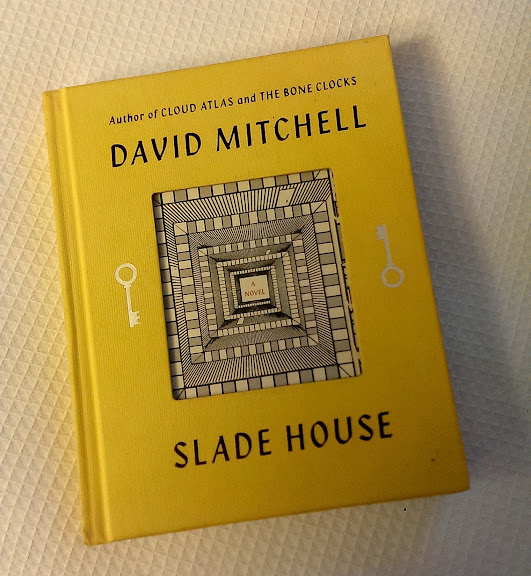
Slade House, by David Mitchell

I really enjoyed this book but explaining why is complicated.

First, I should say that before Slade House, I read every other David Mitchell book except for The Thousand Autumns of Jacob de Zoet*, I believe in this order:

Though I was struck by the gorgeous and skillful language of all five, Bone Clocks was far and away my favorite. Soon after, I read a review in the NY Times where the critic wrote that it "felt like a misfire," with a plot that "felt soft and formulaic" and read "like second-rate fantasy fiction" (of course, I vehemently disagreed!), and that the recurring characters from Mitchell's previous books seemed “less like Yoknapatawpha and more like Marvel.” Not having read any of his other books at the time, this didn't mean much to me, but I did pick up on the fact it wasn't intended as a compliment.

Over the last year, though, I've read everything except Jacob*, so now I see what he was getting at: Although the books are all self-contained, they do all seem to take place in the same universe, with the same characters or clans of characters appearing regularly (sometimes as central figures, sometimes as cameos), and taken as a whole, I could sort of see Mitchell weaving together a larger story, each book existing in its own little narrative eddy. So it was unsurprising to me to hear that Slade House was sort of a sequel to Bone Clocks.

For better or worse, that was the effect of reading Bone Clocks first. It's definitely the most explicit, sprawling, lay-it-all-out, this-is-what's-going type of story of the six, and I can see how someone might not pick up all the connections if they started with Ghostwritten and read according to publication order. I also think maybe that explicitness was what some people didn't like about Bone Clocks, having become accustomed to the oblique nature of the books that came before. (Also, I'm a huge fan of what you might call "intellectual horror" or "literary horror" or whatever, which I think Bone Clocks has a lot in common with, and I can see maybe a subset of Mitchell's usual audience not really going for that.)

So. I say all that to say that if you enjoyed Bone Clocks, you are more likely to enjoy Slade House than if you enjoyed Mitchell's other books more and Bone Clocks less. It's short, apparently an elaboration on a short story he wrote called The Right Sort. If Bone Clocks flirts with intellectual/literary horror, Slade House straight-up propositions it. The story is divided into three parts and revolves around a mysterious manor house (the eponymous Slade House), with each part following a character as they visit the house and its odd inhabitants. Not all of their fates are happy. If you've read Bone Clocks, by the second or third story you see the connection between the two books and will probably figure out sooner than other readers how it's going to end.

I can see why readers who enjoyed Cloud Atlas and Ghostwritten more might not be as big on Slade House. It's short and fairly to the point, not quite as literary, and more focused on telling a grizzly tale than on patiently and artfully developing nine-dimensional characters and abstract, highly literary themes. Still, Mitchell's skill with language and story craft in general shines through, which made it (at least for me) a satisfying, undemanding, yet highly entertaining read.

* I started Jacob in December and abandoned it after 100 pages because I just could not get into it. (Sorry, David Mitchell; six out of seven still ain't bad!)

Tuesday, September 29, 2015

Fates and Furies, by Lauren Groff

Oh, man. I don't even know where to begin with this book except that it was amazing. I actually think the marketing copy included a pretty decent summation: Every relationship has two perspectives, and sometimes the key to a great marriage is not its truths but its secrets.

The relationship in question is that of Lotto & Mathilde, madly in love and married at the tender age of twenty-two after knowing each other for all of two weeks. The first half of the book tells the story of their marriage from Lotto's point of view, and though the writing is utterly gorgeous and the characters dynamic and multi-dimensional, it's on the darker side, without much in the way of comic relief. The second half, though, is Mathilde's story, which fills in a lot of blanks in sometimes jaw-dropping ways. (Fans of Gone Girl and The Girl on the Train, this is why you'll love it.)

The genius of this book lies in the juxtaposition of the two voices, addressing issues of destiny, creative potential, and the nature & meaning of marriage. Not a light read, but beautifully & poetically written without sacrificing the authentic voices of the characters, and the complexity and cleverness offers enough relief from the darker nature of the story to make it brilliant.

Wednesday, September 23, 2015

Books Update: Quarter 3

Fall is finally here, if only officially (did I mention it's been 80s & 90s in San Francisco for weeks? Not okay), and as we close the book on September, it is time once again to speak of, well, books.

As you may already know, I've been reading a classic a month for the last two years. It started as a one-year project in 2014, but I've enjoyed it enough to keep going with it & will probably continue until it starts to feel like a chore.

July: A Prayer for Owen Meany, by John Irving (1990, 637 pages). Ahh, John Irving, you got me again! Sweet, depressing, hilarious, & raw. The story follows Johnny Weelwright (1st person narrator) & his best friend Owen Meany (tiny, brilliant, charismatic, & possessed of a bizarrely shrill voice) from their childhood together in a small town in 1950s New Hampshire through early adulthood, while periodically flashing forward to Johnny's middle age in Canada. The relationship between the two is weirdly cemented when uncoordinated, nonathletic Owen somehow manages to hit a baseball at the end of a Little League game that hits Johnny's mysterious mother in the head, killing her. After that, Owen is convinced he is "God's Instrument," with everything & every moment in his life leading to a single purpose. I think it's the sheer audacity & improbability of the whole thing that made it one of the best books I've read in a while.

August: Jane Eyre, by Charlotte Brontë (1847, 507 pages). I think sometimes it's difficult to fully appreciate classics because the reason they are classics has mainly to do with the context in which they were written. Reading Jane Eyre for the first time in 2015, I have to admit that I spent most of it rolling my eyes & ready to chuck it across the room. Really? Really, Jane? It's so painfully clear that Mr. Rochester is a dire shitbird, and you are utterly pathetic for not realizing this almost immediately. (Though, I will also admit that she gets a little less pathetic as the book goes on, but he is still a shitbird, and their conversations are honestly kind of gross.) BUT, I do get that it was rather revolutionary and radical for 1847 and (kind of hilariously) was actually lambasted for being anti-God/Church (ie, a woman every once in a while having an original thought and maybe occasionally for half a second not doing exactly what some rando self-important dude tells her to do). Still, a part of me was screaming throughout, JANE, YOU IDIOT! DTMFA!

September: The Jungle, by Upton Sinclair (1905, 335 pages).


Welp, I guess I'll go shoot myself in the face now.

The Jungle is about the trials & tribulations of a Lithuanian family that settles in Chicago to pursue the vast riches and endless opportunity that they have heard are there for the taking in welcoming, democratic, class-blind America. Lololololol. No but really, it's one of the most depressing books I've ever read in my life. I get the historical significance of this book and that the fact that it's completely and utterly depressing as hell is the whole point, so three stars for that. But when you have only one color in your palette (shit-color, for instance), it loses its effect real fast & you stop expecting anything else. Most of the other books I've tagged as "depressing as hell" offered at least a few strokes of other colors occasionally, if for no other reason than to provide enough contrast for the horrible parts to maintain their effect (and presumably to stop you from pausing to kill yourself). Not so here. It's shit sandwich after shit sandwich, and any time things start to look maybe-kinda not so bad for the protagonist, you know that a shit sandwich with an extra-crispy cat litter crust is just around the corner.

OTHER RECENT READS:

I have read a lot of stuff lately but here are the titles I most highly recommend:

The Ocean At the End of the Lane, by Neil Gaiman (2013, 181 pages). 5 stars. Beautiful, creepy, imaginative, & sad. Essentially: All things Neil Gaiman. More along the lines of Coraline and The Graveyard Book than Neverwhere / Stardust. Hard to explain any more clearly than that.

Fight Club, by Chuck Palahniuk (1996, 218 pages). 5 stars. I picked this up in the airport because I wanted something short to read on a plane, & having only seen the movie & never read any Chuck Palahniuk, I was curious. Super entertaining & amazingly well-written & well crafted! My only regret is that I wish I'd read it before seeing the movie. I also enjoyed the afterword at the end about how the book began as a six-page short story no one paid any attention to & evolved into an international blockbuster. The question now is, which Palahniuk to read next?

The Blue Girl, by Laurie Foos (2015, 220 pages). 5 stars. A super quick, easy, fairly minimalist read, and at the same time amazingly, gorgeously, breathtakingly written. I'm not sure how you do both of those things at the same time, but somehow Foos pulled it off. A silent blue girl has appeared in an unnamed lake town; after one of their daughters saves the blue girl from drowning, three sad, middle-aged women with sad, middle-aged husbands, teenage daughters, and troubled sons sneak out at night to the cabin in the woods where the blue girl lives with an old woman to feed her the secrets they've baked into homemade moon pies. When the kids catch on, everything changes. Again, I don't understand how she did it, but these 220 dream-like pages weave together some of the most brilliant character development I've read in a while with profound narrative themes & symbolism. Not a wasted word anywhere. Heartbreakingly beautiful.

I'll Give You the Sun, by Jandy Nelson. (2014, 371 pages) 5 stars. This may be the absolute best modern YA novel I've ever read in terms of teenage characters who are actually believable in terms of how they think, act, and (especially) talk. It's also just a lovely, if bittersweet, story about a set of artsy teenage twins trying to navigate their own & each other's tumultuous lives in the wake of their parents' own issues, and manages to strike a nice balance of humor, heartache, sweetness, and raw teenage emotion without veering too much into melodrama (or trying so hard to ape modern teenage lingo that it's painful). Still a *bit* too much schmoopy in places for my taste, but not so much as to make me want to vomit (which more or less seems to be the norm with YA). A great read for 12/13+, but there's plenty going on for adults to appreciate as well.

A Head Full of Ghosts, by Paul Tremblay. (2015, 288 pages) The story follows the Barrett family (out-of-work, hyper-religious John, his cynical, frustrated wife Sarah, and their two daughters Marjorie and Merry, fourteen and eight respectively) as Marjorie descends into (severe mental illness? Demonic possession? A desperate bid to salvage the family's financial situation?). John gets the local minister involved, who in turn gets the family a reality TV deal ("The Possession"), which in turn leads to Complications, all of which is narrated by eight-year-old Merry. The real genius of this book, though, is that it's kind of meta-horror. Instead of telling the story purely from eight-year-old Merry's perspective, Tremblay ups the ante by framing it as told by twenty-three-year-old Merry to a bestselling author who is writing a book about the events, and then interspersing those interviews with blog posts about the reality series "The Possession" written by a quirky & mysterious horror junkie. Because of the reality show, a lot of what happened is on film, but a lot of it isn't; there is also the reliability of Merry's memory to take into account. This all adds up to an undercurrent of uncertainty about what did and did not actually happen and to what extent was the situation was medical, supernatural, or faked by Marjorie and/or the exploitative reality TV producers. Brilliantly written, start to finish.

The Longest Date: Life As a Wife, by Cindy Chupack. (2014, 212 pages) 5 stars. I picked this one up after hearing a podcast interview with Chupack & finished it on a single plane ride. It's pretty short, and manages to be funny and entertaining even when she's writing about some pretty heavy stuff. Even so, she pulls absolutely no punches, laying bare just about every facet of her relationship with her husband, from their courtship as late-thirty-somethings to raising an adopted child at fifty. And I think it's that completely candid openness that makes it such a compelling read. It's not, "Marriage is hard work but if you pick the right person and really love each other and practice gratitude or whatever you'll make it through the tough times." It's more like "I'm the luckiest person alive!" on some days and on others "SWEET JESUS WHAT HAVE I DONE," and for her getting married was agreeing to stick it out, even on the SWEET JESUS days. (That, and coming to terms with the fact that she was a control freak & now had someone permanently in her life that she couldn't control.) If you've ever had a moment when you're like, "Oh god, why can't we be like all those nice, normal people who are super in love all the time & never have any horrible moments together???," this book is a great reminder that nobody is those people, because we are all real, live humans with strengths and flaws and history and baggage, and that's what you sign up for when you marry a real, live human.

Simon vs. The Homo Sapiens Agenda, by Becky Albertalli. (2015, 303 pages) 5 stars. What a sweet, wonderful, (sadly) subversive book. The last twenty pages or so actually had me kind of weepy (in a good way), and if you know me at all you know how rare that is for a book. This and I'll Give You the Sun have reaffirmed my belief that yes, there IS, in fact, really excellent YA left in the world. Like all the best books (I'm discovering), the marketing copy just really does not capture what makes this one so great. Come down to it, it's basically about gay-but-not-out 16-year-old Simon negotiating all the usual sixteen-year-old orders of business (school, friends, family, extracurriculars, crushes, feeling generally awkward & out of place), but with the added wrinkle of an anonymous email penpal about whom he knows nothing except that said penpal is a fellow gay-but-not-out junior boy at his school. Hijinks, turmoil, laughs, and all the feels ensue. (Also, mad props to Albertalli for a) writing a gay protagonist (1st person) who is just a normal kid and b) handling the whole teen boy coming out / figuring out how to relationship in such an earnest, thoughtful, brilliant way, particularly for someone who, as far as I know, has never been a gay boy)..

Fates and Furies, by Lauren Groff. (2015, 392 pages) 5 stars. Oh, man. I don't even know where to begin with this book except that it was amazing. I actually think the marketing copy included a pretty decent summation: Every relationship has two perspectives, and sometimes the key to a great marriage is not its truths but its secrets. The relationship in question is that of Lotto & Mathilde, madly in love and married at the tender age of twenty-two after knowing each other for all of two weeks. The first half of the book tells the story of their decades of marriage from Lotto's point of view, and though the writing is utterly gorgeous and the characters dynamic and multi-dimensional, it's on the darker side, without much in the way of comic relief. The second half, though, is Mathilde's story, which fills in a lot of blanks. The genius of this book lies in the juxtaposition of the two voices, addressing issues of destiny, creative potential, and the nature & meaning of marriage. Not a light read, but the complexity and cleverness offers enough relief from the darker nature of the story to make it brilliant.

* * *

Currently Reading:
The Fifty Year Sword, by Mark Z. Danielewski

Currently Listening To:
Middlesex, by Jeffrey Eugenides

Up Next:


Taking future suggestions as always. :)

Tuesday, September 22, 2015

Simon vs. the Homo Sapiens Agenda, by Becky Albertalli

What a sweet, wonderful, (sadly) subversive book. The last twenty pages or so actually had me kind of weepy (in a good way), and if you know me at all you know how rare that is for a book. This and I'll Give You the Sun have reaffirmed my belief that yes, there IS, in fact, really excellent YA left in the world.

Like all the best books (I'm discovering), the marketing copy just really does not capture what makes this one so great. Come down to it, it's basically about gay-but-not-out 16-year-old Simon negotiating all the usual sixteen-year-old orders of business (school, friends, family, extracurriculars, crushes, feeling generally awkward & out of place), but with the added wrinkle of an anonymous email penpal about whom he knows nothing except that said penpal is a fellow gay-but-not-out junior boy at his school. Hijinks, turmoil, laughs, and all the feels ensue.

Really, what makes this book so fantastic (besides the fact that it's just really well written overall) is the genuine, believable feel of all of it. The kids sound, act, and talk like real teenagers and, like real teenagers, can't be easily pigeon-holed into the stereotypes that plague so much YA media (the bully, the hot girl, the nerd, the jock, the theater geek, etc.). High school feels like an actual, run-of-the-mill suburban high school and not like college or Gossip Girl or Saved By the Bell, which I feel like is something that adults who have not spent massive amounts of time in ordinary high schools with ordinary teenagers seem to lose sight of sometimes.

Also, mad props to Albertalli for a) writing a gay protagonist (1st person) who is just a normal kid and b) handling the whole teen boy coming out / figuring out how to relationship in such an earnest, thoughtful, brilliant way (particularly for someone who, as far as I know, has never been a gay boy). I basically want to give this book to everyone I know, so they can give it to everyone they know. All the stars.

Monday, September 14, 2015

A Head Full of Ghosts, by Paul Tremblay

Last Wednesday I read an article on LitReactor called "6 Reasons Everyone Should Read "A Head Full of Ghosts" by Paul Tremblay". Apparently this book has been getting rave reviews by everyone and their mother since it came out in June, but this was the first I'd heard of it. I am not much of a horror fan so I suspected it wouldn't really be my thing, but LitReactor has often steered me very very right, so I read the article. And got the book the next day, and read it the day after that.

Friends: I could not put it down. It is for sure one of the best books I've read this year, and yet 100% completely different from anything else I've read this year.

I owe the LitReactor article a lot, because the genius of this book is not really the kind of genius that is conveyed easily in a two-paragraph marketing blurb. The story follows the Barrett family (out-of-work, hyper-religious John, his cynical, frustrated wife Sarah, and their two daughters Marjorie and Merry, fourteen and eight respectively) as Marjorie descends into (severe mental illness? Demonic possession? A desperate bid to salvage the family's financial situation?). John gets the local minister involved, who in turn gets the family a reality TV deal ("The Possession"), which in turn leads to Complications, all of which is narrated by eight-year-old Merry.

That's basically the setup you get from the marketing copy, and based on that alone I probably would have skipped it because a) not really into horror and b) sounds a bit cliché, to be honest. But the real genius of this books is that it's kind of meta-horror. Instead of telling the story purely from eight-year-old Merry's perspective, Tremblay ups the ante by framing it as told by twenty-three-year-old Merry to a bestselling author who is writing a book about the events, and then interspersing those interviews with blog posts about the reality series "The Possession" written by a quirky & mysterious horror junkie. Because of the reality show, a lot of what happened is on film, but a lot of it isn't; there is also the reliability of Merry's memory to take into account. This all adds up to an undercurrent of uncertainty about what did and did not actually happen and to what extent was the situation was medical, supernatural, or faked by Marjorie and/or the exploitative reality TV producers.

In that context, the various horror clichés and tropes click into place. Rather than making the story predictable and derivative, they add layers of complexity to it and enrich the question of real/not real/supernatural/fake, and give the horror junkie blog posts lots to dig into in that obsessive-internetty-kind of way that the best bloggers have.

Finally, the dang thing is just brilliantly written, start to finish. As the LitReactor article put it, there are no bit parts. The real conflict & tension in the book is created by the interplay between complex, three-dimensional characters with vastly different goals and desires and understandings of what's happening. (I was particularly impressed with how believably eight-year-old Merry was written.)

All that said, A Head Full of Ghosts will not be for everyone. There are some disturbing scenes that, while they make complete sense in context and are not played for shock value, will be deal breakers for the squeamish (and possibly hyper-religious). But if you're more concerned with a smart, tense, well-written story that hooks you from the first page, you might give it a shot.

Books with which [book:A Head Full of Ghosts|23019294] has things in common, but is completely different than:

Friday, August 28, 2015

Jane Eyre, by Charlotte, Brontë

August's 2015 Classic Read was Jane Eyre, by Charlotte Brontë!

I think sometimes it's difficult to fully appreciate classics because the reason they are classics has mainly to do with the context in which they were written. Reading Jane Eyre for the first time in 2015, I have to admit that I spent most of it rolling my eyes & ready to chuck it across the room. Really, Jane? Really? It's so painfully clear that Mr. Rochester is a dire shitbird, and you are utterly pathetic for not realizing this almost immediately. (Though, I will also admit that she gets a little less pathetic as the book goes on, but he is still a shitbird, and their conversations are honestly kind of gross.)

BUT, I do get that it was rather revolutionary and radical for 1847 and (kind of hilariously) was actually lambasted for being anti-God/Church (ie, a woman every once in a while having an original thought and maybe occasionally for half a second not doing exactly what some rando self-important dude tells her to do). Still, a part of me was screaming throughout, JANE, YOU IDIOT! DTMFA!